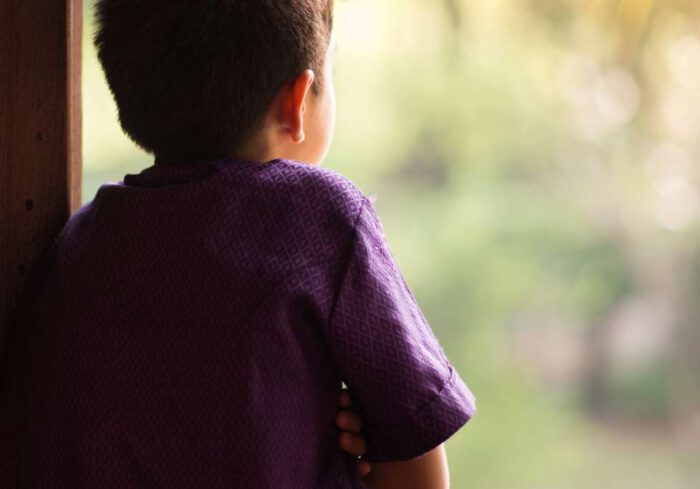
Through Their Eyes: Understanding Divorce from a Child’s Perspective
Separation and divorce are adult decisions, but they are experienced deeply and personally by children. At Rise Up…
+ Read More
When parents separate, children are often placed in emotional positions they never asked to be in. One of the most common and least understood, of these is something called a loyalty bind.
Loyalty binds are not always obvious. They don’t always come from direct comments or intentional behaviour. In fact, many loving, well-intentioned parents create loyalty binds without realizing it. Yet the impact on children can be profound.
Understanding loyalty binds and learning how to prevent them is one of the most powerful ways parents can protect their children’s emotional wellbeing during and after divorce.
A loyalty bind occurs when a child feels that loving, enjoying time with, or speaking positively about one parent is a betrayal of the other parent.
Children caught in loyalty binds may feel that they have to choose sides, protect one parent’s feelings, or minimize their connection with the other parent in order to stay emotionally safe.
This doesn’t always happen because a parent says something directly. Often, it is subtle:
Children are incredibly sensitive to these cues. They quickly learn what feels “safe” to say and what does not.
Adults often understand separation as the end of a relationship. Children don’t experience it that way.
For children, both parents are part of the same internal family system. They don’t stop loving one parent when the other parent becomes upset or angry. Instead, they carry both relationships inside them at the same time.
When parents are in conflict, children may feel:
In many cases, children cope by emotionally shrinking, saying less, sharing less, or disconnecting from their own needs in order to keep the peace.
Children experiencing loyalty binds may not say, “I feel stuck between my parents.” Instead, you might notice:
Over time, children may internalize the belief that their needs, feelings, or attachments are dangerous or burdensome.
When loyalty binds persist, they can affect a child well beyond the separation itself.
Children may grow up struggling with:
These outcomes are not inevitable, but they are more likely when children are repeatedly placed in positions where love feels conditional.
One of the most protective things a parent can do during divorce is give their child emotional permission to love both parents freely.
This means communicating, verbally and non-verbally that:
Even simple statements can be powerful:
Preventing loyalty binds doesn’t require perfect co-parenting or the absence of conflict. It requires awareness, intention, and repair.
There will be moments when emotions leak through. What matters most is what happens next.
Parents can repair by:
Children don’t need perfection, they need honesty and reassurance.
In some families, loyalty binds become deeply ingrained, particularly when conflict is ongoing, communication is strained, or children have already taken on emotional caretaking roles.
Therapeutic support can help:
At Rise Up Counselling, we work with parents and children to untangle these dynamics in a way that is respectful, child-centred, and grounded in emotional safety.
Separation and divorce are adult decisions, but they are experienced deeply and personally by children. At Rise Up…
+ Read More
When we talk about divorce, much of the focus is on how separation affects young children. We discuss…
+ Read More
Separation and divorce rarely exist in isolation. Families navigating this transition are often supported by a network of…
+ Read More